Screen Time Destroyed Their Focus: How I Taught Them to Tune In
Screen time was destroying my kids’ focus and sleep, so I used a simple screen-time reset to rebuild their attention, calm, and real-world creativity.
When Educational Screen Time Still Hurts Kids
Screen time destroyed my kids' ability to focus, even though they only got 30 minutes of iPad time on weekdays for educational apps and TV just on weekends. No games, no YouTube, all productive stuff. But their brains were still getting hijacked. Here are the boundaries that brought back their attention spans.
When Screens Became a Survival Strategy
So when we moved to Dubai, life was just... a lot. You know those seasons as a mum where you are just trying to survive? We had boxes everywhere, paperwork that never seemed to end, everything felt chaotic. And honestly, screens became our lifesaver. They bought us time when we desperately needed it.
But here is what I did not realise. The cost was adding up slowly. My kids were sleeping worse, having bigger reactions to everything, and suddenly they could not think of a single thing to do that did not involve a screen. So today I am going to share exactly what I saw happening, what the research actually says about this stuff, and the specific things we changed that brought back their focus.
There is this one tiny change I made to where we keep art supplies that turned my daughter into this little artist who paints every single day now. And there is a bedtime thing we started doing that gets my son to sleep in under an hour instead of lying there till eleven. I will show you both.
When Screens Took Over Everything
The Meltdown That Opened Our Eyes
So picture this. It is a regular afternoon, right? My daughter is watching some Disney movie, totally absorbed, and I am thinking this is perfect. She is happy, I am getting stuff done, everyone is content.
Then the credits start rolling.
I say, "Okay sweetheart, movie is over, let us get ready to go out."
What happened next still haunts me a little. She did not just whine or try to negotiate like kids usually do. She literally crumpled to the floor like I had physically hurt her. The screaming was intense, like neighbours might call the police intense. She was kicking, thrashing around, completely inconsolable.
When I tried to comfort her, she pushed me away, her whole body just rigid with rage. This was not a normal tantrum. This was withdrawal. Like I had taken drugs away from someone who was addicted.
Standing there watching my normally sweet little girl turn into this stranger, I realised something terrifying. Screens were not just babysitting my kids. They were controlling them.
The Dubai Chaos and “Temporary” Habits
When we first got to Dubai, everything felt temporary. We were living out of suitcases, dealing with visa stuff, trying to figure out schools, completely overwhelmed by moving a family to a whole new country.
Weekends became survival mode. TV on so we could deal with boxes. iPad out so we could make important phone calls without interruptions. I kept telling myself it was just until we got settled, just until life went back to normal.
But here is the thing about temporary habits. They do not stay temporary. They become your new normal before you even notice it has happened.
By the time our furniture finally arrived and we should have had our act together, the pattern was already set. Screens had become our default answer to everything. Bored? Screen. Need quiet time? Screen. Need the kids occupied? Screen.
The Good Kid Who Started Falling Apart
Fast forward to this past September. We had been here over a year and I thought we had everything under control. My eight-year-old goes back to school after summer holidays and that is when everything started going sideways in ways I did not see coming.
His school uses iPads a lot. Two to three hours a day. And I was not worried about it because it is all educational, structured stuff. Then he would come home and use the iPad for what I considered good things. Duolingo for languages, making projects on Canva for school. No games, no mindless YouTube videos, nothing that felt like a waste of time.
I actually felt pretty smug about how we handled screen time. This was not some kid zoned out watching cartoons. He was learning, creating, being productive.
But when I actually added up the hours?
School: three hours.
Home: at least an hour, sometimes more.
That is four hours of screen time every day, even though every minute felt justified.
And that is when the wheels came off.
Bedtime became a nightmare. We would put him in his room at 7.30 like always, but at eleven o’clock I would still hear him tossing around, his brain too wired to shut down. Then he would be up at 4.30 or 5 in the morning, already alert and bouncing off the walls. The kid was getting maybe five or six hours of broken sleep.
But it was not just the sleep thing. His emotional reactions went completely off the rails. I would ask him to put his shoes away, and suddenly doors were slamming. I would say it is time for dinner, and he would explode about how unfair everything is. These were not normal kid moments. These were volcanic eruptions over absolutely nothing.
The kid who used to read for hours straight stopped picking up books entirely. The one who would spend Sunday afternoons building elaborate Lego cities could not focus on anything for longer than ten minutes. Everything became boring unless it involved his iPad.
And here is what really got to me. Even though I had all these parental controls set up, even though I had blocked certain apps and websites, he kept finding ways around them. I would block an app, and he would figure out the browser version. I would restrict a website, and he would find some other way to get to the same content.
These kids grew up with this stuff. They do not just use technology. They think like it. While I am playing catch-up trying to figure out controls, he is already three steps ahead of me.
Watching him became heartbreaking. This was not the kid I knew. The one who could disappear into a book so completely I would have to call his name three times to get his attention. The one who would wake up on weekends already excited about what he wanted to build.
Instead, I had this child who woke up asking for his iPad, went to sleep thinking about his iPad, and seemed genuinely incapable of enjoying anything that did not involve a screen.
And that is when I started thinking maybe all this educational screen time was not as harmless as I had convinced myself.
So I started digging into what actually happens to kids' brains when they are on screens all the time. Even the good, educational stuff. And everything clicked.
What Screens Really Do to Kids’ Brains
Why Kids Can’t Sleep After Screen Time
Let us start with sleep, because everything else builds from there. Any screen, educational or not, messes with kids' natural sleep patterns in ways that ripple through their entire day.
Screens emit blue light that tricks your brain into thinking it is still daytime, which messes with melatonin, the hormone that makes you sleepy. For adults, maybe we stay up a bit later than usual. But for kids whose sleep systems are still figuring themselves out, it can wreck everything.
They have found that just turning off screens an hour before bed helps kids fall asleep faster and sleep way better. But research does not tell you what it is like living with a chronically sleep-deprived kid.
No wonder my son was still wired at eleven after using his iPad until eight or nine at night. His brain was getting mixed messages. The content might have been educational, but the light was telling his system to stay alert, stay engaged, stay awake.
Screen Time Changes the Developing Brain
What really freaked me out was learning how screen time changes the actual structure of developing brains.
They have done brain scans on little kids and found that heavy screen time weakens the connections in areas that handle language, attention, and reasoning. And this is not temporary. This is literally how their brains develop differently.
Here is how I think about it. Your brain becomes whatever you do the most. So if a kid is getting hours of fast-paced digital stimulation every day, their brain gets really good at that. But the slow, focused attention they need for reading a book or building something or working through a problem becomes super hard because their brain never developed those pathways properly.
It is like if you only ever trained a muscle to do quick, jerky movements. Eventually it would lose the ability to do slow, steady work. That is what is happening with their attention spans.
The “Domino Effect”
Then I started looking into attention and self-control. Basically all those mental skills that help kids focus on stuff, remember what you told them to do, and not have a complete meltdown when things do not go their way.
Study after study keeps finding the same pattern. Kids getting more screen time struggle with impulse control, their memory gets weaker, and they start showing ADHD-type behaviours. They cannot switch between activities without drama, they cannot focus on anything unless it is immediately exciting, and their emotional reactions go off the rails.
Those twenty-times-bigger responses to simple requests? His brain had not developed the skills to handle frustration and transitions. Constant screen stimulation had kept his nervous system in a heightened state where everything felt more intense and overwhelming.
Why Early Screen Time Has Long-Term Impact
What really freaks me out is the research on little kids. They have followed babies into their teen years and found that too much screen time in those first few years sets kids up for weaker self-control and attention problems that stick around for years.
Look, I am not anti-technology at all. It is about timing. Those crucial brain pathways for focus, emotional control, impulse control are developing like crazy in early childhood. Whatever kids experience during those critical windows shapes how well they will be able to learn and regulate themselves down the road.
Even those educational apps we feel good about can interfere if little kids are using them too much during sensitive periods.
Why “Good Screens” Are Still Screens
Here is what finally convinced me we needed to change course. Even the highest quality educational content still floods kids with blue light and overstimulation. The brain does not care whether screen time is good or bad when it comes to sleep disruption and attention problems.
Those Duolingo sessions and Canva projects that felt so productive were still bombarding my son's developing visual system with artificial light and rapid-fire stimulation. His brain was getting the message to stay alert and engaged when what he actually needed was to wind down and process his day.
So if you are seeing bedtime battles, explosive reactions over tiny things, and a kid who cannot think of anything fun to do without a screen, even when their screen time feels educational and worthwhile, you are not losing your mind. The answer is not becoming anti-technology. It is about being intentional with it.
The Screen Time Resets That Actually Worked
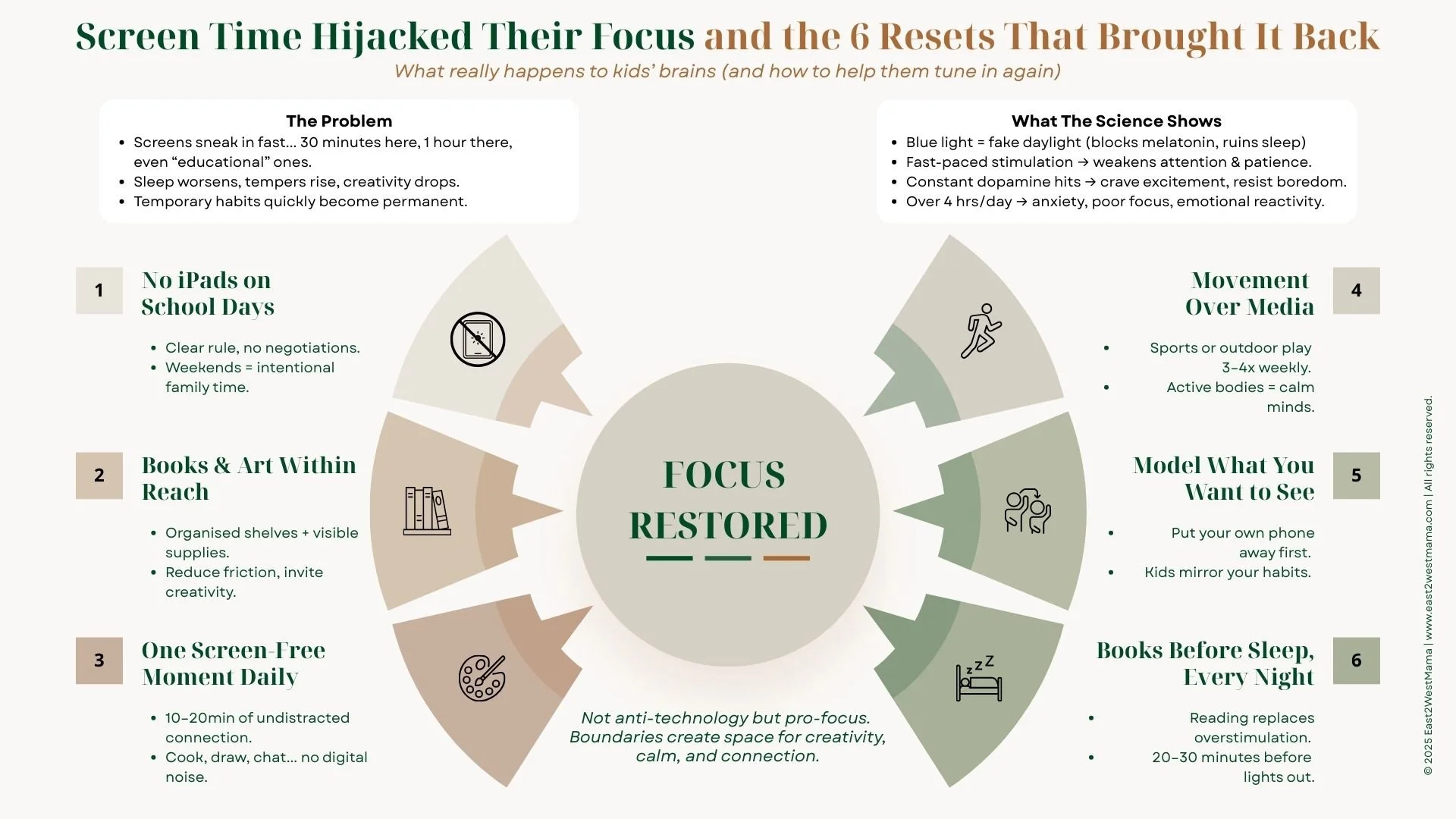
1. No iPads on School Days
The first change was the hardest but most game-changing. No iPad at home on school days. Full stop.
This was not gradual reduction or earning screen time through good behaviour. It was just a clear boundary. My son was already getting two to three hours at school, adding more at home was pushing his developing brain past what it could handle.
Some weekends became completely screen-free. If we were out at the beach, having friends over, or exploring Dubai, there was no space for digital entertainment. Other weekends he might watch a family movie, but that was intentional, together time, not solo screen consumption.
The first week was brutal. Constant complaining, trying to negotiate with me, telling me I was the worst mother in the world. But around day ten something weird happened. He stopped asking. Not because he had forgotten about it, but his brain had started getting used to a completely different routine.
By week three, the difference was night and day. He would fall asleep within an hour instead of tossing around until eleven. He would sleep until a normal time instead of waking up at 4.30 in the morning. Those over-the-top reactions went back to being regular kid moments.
But what really blew my mind was watching him fall back in love with books. This kid who had not touched a book for fun in months started picking them up again. Not because I was pushing him or bribing him. His brain finally had space for slow, quiet focus again.
2. Books and Art Within Reach
The second thing I did was reorganise our space to actually encourage the behaviour I wanted to see. It sounds simple, but it completely changed how my kids interacted with everything.
I started with their books, which were honestly a disaster. All the kids' books were thrown together on one overcrowded shelf. Picture books mixed in with chapter books, my daughter's little readers buried under my son's huge novels. It looked chaotic and overwhelming, so they never bothered looking.
So I split them up. My five-year-old got her own little shelf with books at her level that she could actually see. My eight-year-old got his own section with all his chapter books sorted by series.
The difference was instant. Instead of walking past a messy, intimidating pile of books, they each had their own neat collection that looked appealing. My daughter started grabbing books throughout the day. My son went back to picking up books for fun.
But the most dramatic change came from one simple switch in the living room.
My daughter has always loved art, but all her supplies were stored in her bedroom. Every time she wanted to paint or draw, she had to gather everything, carry it to the living room where she preferred to work, and then clean it all up. That tiny inconvenience was enough to stop her most of the time.
So I moved some of her toys from the living room to her bedroom and set up a proper art station in the main space. Paints, brushes, paper, coloured pencils, everything she needed, right there, organised but accessible, exactly where she naturally wanted to create.
The result? She has painted every single day since I made that change.
Not because I am prompting her or setting up activities. When inspiration hits, there are zero obstacles. She is experimenting with mixing colours, trying new techniques, developing her own style. The kid who used to ask for screen time now automatically reaches for a paintbrush.
This taught me something huge about kids' natural instincts. They want to create, explore, and engage with the physical world. But if we make those experiences harder to access than digital entertainment, we are accidentally steering them toward screens.
3. One Screen-Free Moment Daily
I realised connection is a basic human need, especially for kids, so I made one screen-free activity together non-negotiable each day. Not elaborate Pinterest projects. Just ten to twenty minutes of focused, shared attention.
With my daughter, this usually looks like painting or doodling side by side. Not me teaching or directing. Just both of us creating while we chat about her day, her ideas, whatever is on her mind.
With my son, it might be a quick card game, helping me prep dinner, or sitting together while he reads me something from his current book.
These were not grand gestures or Instagram-worthy activities. Just simple moments of being present with each other without digital distractions competing for attention. But the impact was way bigger than the effort involved.
Kids who feel genuinely connected to their parents are much less likely to seek stimulation from screens. When they know they have dedicated time for real interaction, they are more content playing independently for the rest of the day.
4. Movement Over Media
Living in Dubai makes kids' physical activity tricky. The heat means outdoor play is limited to early mornings, late evenings, and the cooler months. Without planning, it is easy for kids to become couch potatoes.
I used to resist scheduled activities because I thought kids needed more free time, more chances to be bored and figure out their own entertainment. And I still think that is important. But I realised if the choice was between structured physical activity and passive screen time, I would pick movement every time.
We signed both kids up for sports three to four days a week after school. Not every day. They still have time for free play and rest. But enough to ensure their bodies get the physical output they need for healthy brain function.
The science is clear. Physical movement supports attention, emotional regulation, and sleep quality. Kids who move regularly have better focus, less anxiety, and more stable moods.
Within weeks of this new rhythm, both children were more emotionally balanced. The restless energy that used to come out as irritability and fidgeting had a productive outlet. They were tired in a good way at bedtime, making sleep come naturally.
5. Model What You Want to See
Kids learn more from what we do than what we say, especially with technology. I realised my own device habits were sending mixed messages about when and how screens should fit into our lives.
I started being more intentional about putting my phone away during our time together. Not making a big show of it, just setting it aside and being fully present for conversations, meals, activities.
I also began talking openly with my kids about how different choices affect our brains and bodies. We discuss how movement gives us energy, how certain foods help us think clearly, how screens can be useful tools but can also make it harder to sleep and focus if we use them too much.
This was not about making technology seem scary or forbidden. It was about helping them develop awareness of how their choices affect how they feel and function.
When they saw me choosing a walk over phone scrolling, or picking up a book instead of turning on Netflix, they absorbed these patterns as normal and desirable.
6. Books Before Sleep, Every Night
The other big game-changer was bringing back reading before bed and making it totally non-negotiable. This was not an elaborate routine. It helped them wind down, got their brains used to focusing on non-screen stuff, and gave us proper one-on-one time.
With my eight-year-old, it is straightforward. Twenty to thirty minutes of reading by himself before lights out. No bargaining. No "can I finish this first?" Just him, a book, and quiet time for his brain to chill out.
My daughter needs a bit more structure. She reads one book to me, something she can handle that makes her feel capable, then I read one to her that is a little harder.
This completely changed things for my daughter. She had convinced herself she could not read and would get frustrated when words were tricky. But having daily, no-pressure time in a cosy spot gradually broke down that wall she had built up.
Now I catch her grabbing books during the day, trying to sound out words on cereal boxes, getting curious about text instead of stressed. That confidence from our bedtime routine has spilled over into everything else she is learning.
Getting Other Parents On Board
One of the hardest parts about setting these boundaries was dealing with social pressure. My son would come home saying, "But my friend gets YouTube during playdates" or "Everyone else gets their iPad after school, why cannot I?"
I was tired of feeling like the mean mum, so I reached out to the parents of his closest friends. I figured I would either discover I really was being too strict, or find out I was not alone.
Turns out every single family was dealing with the same stuff. The kids had been playing us against each other, telling each parent that the others were more relaxed about screen time, when really we were all struggling with the same battles at home.
Once we talked honestly, everything got easier. We agreed that playdates would be screen-free unless we specifically planned a movie afternoon and everyone was on board.
This stopped all the constant negotiating and comparing. The kids could not pit us against each other because we were on the same page.
Having that parent backup made everything easier. Instead of feeling like the strict one ruining everyone’s fun, I felt like part of a team who were trying to do what was best for our kids, even when it was not the most convenient thing.
The Results. A Completely Different Home
This did not happen overnight, but within a month our house felt different. Not like we became a perfect family. Kids are still kids and they still have their moments. But everything was calmer, more creative, more connected.
Now I see my kids choosing books instead of complaining they are bored. My daughter is trying painting techniques I never showed her. My son is building elaborate structures and getting lost in chapter books the way he used to get absorbed in screens.
But honestly, the biggest thing is they are sleeping properly, not losing their minds over every little thing, and they are actually curious about the world around them instead of restless all the time.
What Changed Most Was Me
Looking back on all of this, I realise the biggest change was not in my kids. It was in me finally understanding what they actually needed.
I did not turn into an anti-screen person. I became someone who cares more about my kids being able to focus, connect with people, and experience being a kid. I figured out that setting boundaries is not about being restrictive. It is about giving them the space to let their natural creativity and curiosity come back.
Organising the space better, sticking to routines, being intentional about how we spend time. It is not about perfection. It is about setting things up so my kids can develop the ability to pay attention, stay emotionally balanced, and engage with what is happening around them.
Watching them get back to playing deeply, creating things, and concentrating quietly reminded me why this matters so much. We are living in a world that is constantly pulling our attention in every direction. Helping kids learn to focus properly is not optional anymore. It is essential.
Start Small. Watch What Happens
If any of this sounds familiar, the bedtime chaos, the over-the-top reactions, hearing "I am bored" fifty times a day, you do not need to overhaul your whole life to see changes. Just pick one small thing and stick with it.
Maybe it is no screens after dinner. Or organising the books so kids can find something they want to read. Or moving art supplies to where they will actually get used. Even starting a simple bedtime reading routine can make a difference.
What I did not expect was how much better my kids became at focusing once their brains were not constantly overstimulated. I even noticed it in how they were doing their daily Kumon work. Way more concentration, less fidgeting, actually enjoying the challenge.
Now I know what you are thinking. Wait, you are a Montessori mum who does Kumon? Are they not opposites? That is exactly what I thought, until I discovered they share more principles than I ever imagined.
I am going to show you how Kumon can align with Montessori values in my next post. The five core principles I found completely changed how I think about structured learning. If you have wondered whether you can honour your child's natural development while still building solid academic skills, this might surprise you.