6 Easy Ways to Help Your Third Culture Kid Feel Rooted (No Matter Where You Live)
Raising Third Culture Kids abroad: how to build identity, protect heritage culture, support bilingualism, and help your child feel rooted anywhere in the world.
I had a strong Indian upbringing… festivals, family, prayers, the whole thing.
My kids think they're British.
And it took me nine years to realise I had drifted so far from my own culture, there was nothing left to pass on.
What Is a Third Culture Kid?
Before I tell you what went wrong, let me explain what we are actually talking about.
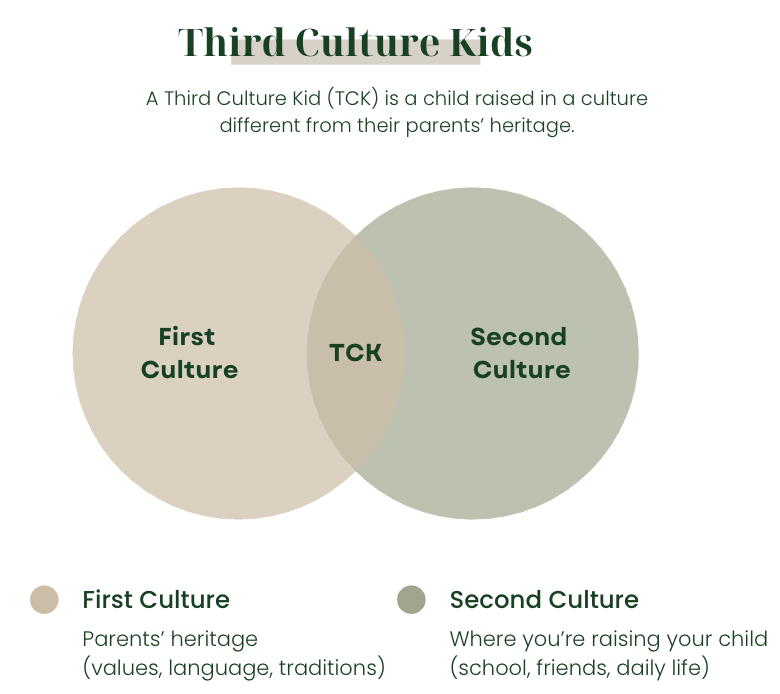
A Third Culture Kid, or TCK, is a child who is raised in a culture that is different from their parents' heritage.
And here is how it breaks down:
First culture: that is your parents' heritage. For us, that is Indian.
Second culture: that is the country where you are actually raising your kids. For us, that was the UK, and now it is Dubai.
Third culture: that is your child's unique, blended identity. It is not fully Indian. It is not fully British. It is something entirely their own.
And this is way more common than you might think.
Expat families. Immigrant families. Diplomats. Military families. International school kids. Digital nomads. Refugees. If you are raising kids across borders, you are raising Third Culture Kids.
In today's global world, there are nearly 250 million people living as expats. That is the equivalent of the world's fifth largest country.
And I was one of them. My kids are too.
My Story
I was born in Singapore. Raised in a home where being Indian was not something we talked about, it was just everywhere.
Diwali meant the whole house lit up with diyas, those little oil lamps glowing in every corner. Bollywood and Hindi TV serials constantly blasting on TV. Reading Amar Chitra comics that told stories from the Ramayana and Mahabharata. The smell of pakoras frying in the kitchen, this crispy, addictive snack that my grandmother made by hand.
Hindi and Sindhi mixing with English in every conversation. Prayers every morning. Festivals and a reason to visit the temple every month.
I had grandparents around. Aunties and uncles popping by unannounced. A whole community reinforcing who I was, where I came from, what mattered.
So even though I was technically a Third Culture Kid myself, born in Singapore to Indian parents, I felt deeply rooted in my Indian heritage.
And when I became a mother, I just assumed I would pass this on. Naturally.
I thought it would happen the way it happened for me.
But my life looked nothing like my mother's life.
I moved to London. Married an Indian man from my own culture. But from the moment my kids were born, they had no grandparents nearby. No aunties dropping by with sweets and gossip. None of the community that had kept me connected to my culture.
I did not expect the onus to fall completely on me.
If I did not teach them Hindi or Sindhi, no one would. If I did not tell them the stories from our scriptures, they would never hear them. If I did not celebrate the festivals, cook the food, explain the traditions, they would grow up thinking Diwali was just some random day in October.
To be perfectly honest,
I did not prioritise it.
I was a new mum. I was overwhelmed. I was drowning in nappies and sleepless nights and trying to figure out how to keep two tiny humans alive.
I was studying for my Montessori diploma, building my coaching business… and just surviving.
Cultural transmission felt like a luxury I could not afford.
A typical week in London looked like this.
Wake up. Breakfast with the kids. School run. Work out. Course work. Lunch. More work. School run again. Homework with the kids. Activities. Bedtime routine. Night classes three nights a week.
Rinse and repeat.
There was no culture built into our week. None.
But there was something else happening too. Something I did not even notice at first.
Living in London for eleven years, I started drifting from Indian culture myself.
I was not going to the temple. I was not reading our scriptures. I was not even cooking Indian food that often because the kids preferred pasta.
I was so busy adapting to life in the UK, trying to fit in, trying to build a life there, that I let go of my own roots without even realizing it.
And then one day, my husband was watching cricket. India was playing. And my eldest son, he was five years old, was cheering for India along with his dad.
And I said something like, “That is right beta. We are Indian.”
And my son looked at me. Dead serious. And said:
“But I am not Indian. I am British. My passport says so.”
I laughed it off. I thought it was cute. Five-year-olds say the funniest things.
But later that night, I could not stop thinking about it.
He was not Indian. Not to him.
To him, he was the same as his British classmates. His Polish classmates. His Iranian classmates. His Asian classmates.
He did not see colour. He did not see culture. He just saw friends.
And in some ways, that is beautiful. That innocence. That openness.
But in other ways,
it terrified me.
The Challenges Third Culture Kids Face
And as I watched my kids grow up, I started seeing what so many Third Culture Kids struggle with.
The biggest one was identity.
1. Identity Confusion
Where are you from?
For most people, this is a simple question. You answer it without thinking.
But for Third Culture Kids, it is agony.
My kids would say London because that is where they lived. But when we would visit Singapore, which is where I grew up, people would ask them where they are from, and they would say London, and everyone would look confused because they looked Indian and had Indian names.
And when they would visit the UK, people would ask where they are from, and they would say London, and people would say, No, but where are you really from, because they did not sound fully British. They had this slight international twang.
So they learned to answer differently depending on who was asking. Chameleons, constantly adjusting.
Third Culture Kids are developing their identity while straddling multiple cultures. They might look like they belong to one culture, sound like they belong to another, and actually feel most comfortable in a third culture made up of other international kids.
This creates what researchers call cultural ambiguity. They are not fully one thing or another.
2. Language Loss
Then there is language loss.
My kids would understand me when I spoke Hindi or Sindhi, our dialect, but they would always answer back in English.
And whenever I would try to speak to them in Hindi, my son would say:
“Why are you talking to me in THAT language?”
That language. Like it was foreign. Like it was not his.
And I watched their heritage language fade, bit by bit, until it was almost completely gone.
Children learn the language that is most useful to them in their daily environment. If they are going to school in English, playing with friends in English, consuming media in English, English becomes their dominant language, even if it was not their first language.
And language is not just about words. It is deeply tied to culture.
3. The Hidden Immigrant Experience
There is also this thing called being a hidden immigrant.
My kids look sort of Indian. They have Indian names.
So when we would visit India, everyone assumed they belonged. That they understood the culture, the customs, the unspoken rules.
But they did not.
My niece, same age as my younger daughter, could recite prayers, count in Sindhi, sing cultural songs.
My kids just stared. Stunned.
They did not understand a single word.
This is what is called the hidden immigrant experience.
People assume you belong, and expect fluency you do not have.
The result is that they feel like imposters in their own heritage. They do not fully belong to their passport culture, but they also do not fully belong to the culture they grew up in.
4. Reverse Culture Shock
And then there is reverse culture shock.
This is when Third Culture Kids visit their parents home country and feel more foreign there than they do anywhere else.
My kids would go to India and feel overwhelmed. The noise. The chaos. The heat. The fact that everyone spoke Hindi so fast they could not keep up. The food was too spicy. The water made them sick.
Things that should have felt like home, felt completely alien.
And then they would feel guilty about it.
Reverse culture shock comes with shame and confusion, because you feel like you should belong. Everyone else assumes you belong. But you do not feel it.
This can lead to what researchers call unresolved grief, a sense of loss for a homeland you never really had.
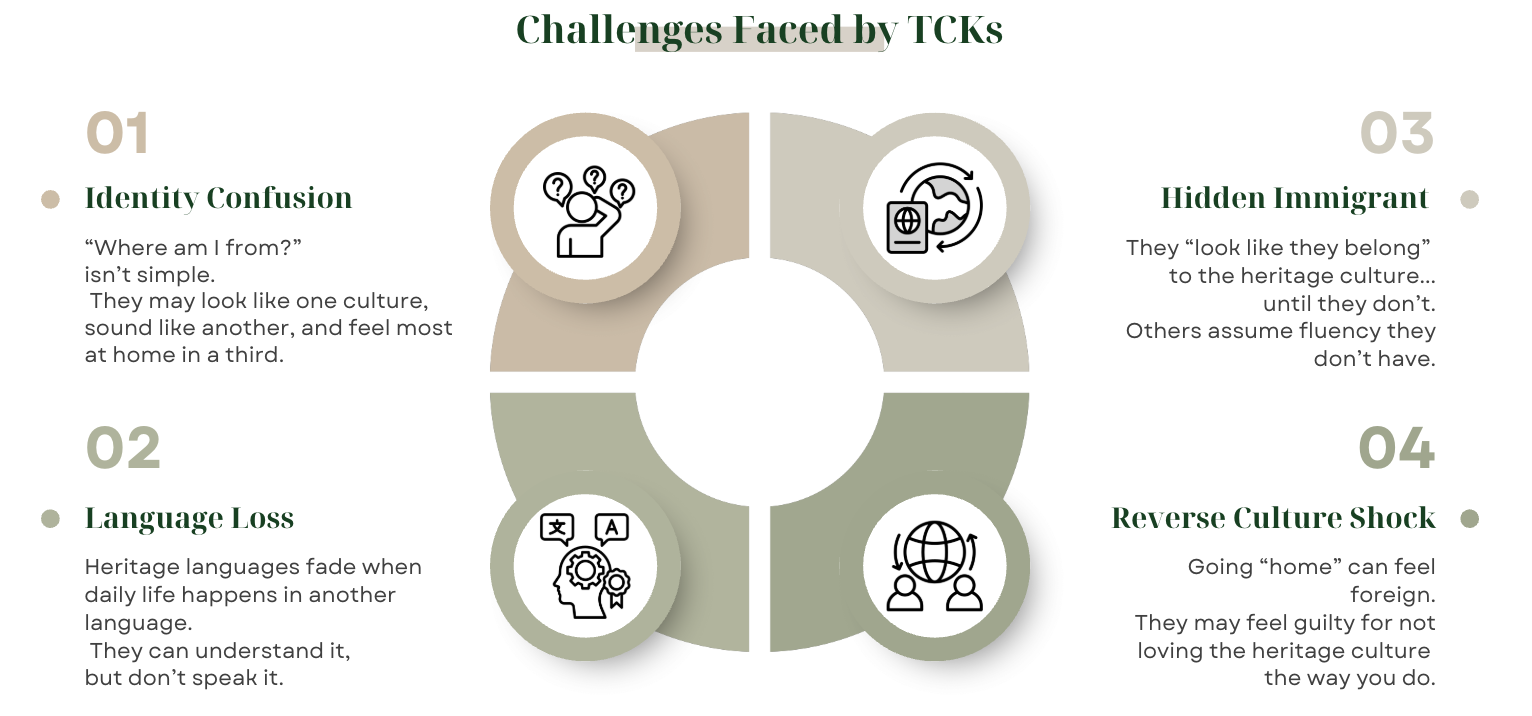
These are the challenges. The identity confusion. The language loss. The hidden immigrant experience. The reverse culture shock.
And for years, I watched my kids navigate all of this. And I did not know how to help them.
Because I was drowning in guilt myself.
The Superpowers Third Culture Kids Gain
But it took me years to see that all of these challenges are also creating superpowers.
My kids can walk into any room, any country, any culture, and feel comfortable. Because they have been outsiders their whole lives. They know how to adapt.
They can read a room. They can pick up on social cues. They know when to speak up and when to hold back.
Research on Third Culture Kids has identified several consistent strengths that emerge from this lifestyle.
1. Enhanced Cultural Intelligence
This is the ability to function effectively in culturally diverse settings.
They develop cultural code-switching, shifting behaviour depending on context.
2. Advanced Cognitive Flexibility
Growing up between cultures requires constant flexibility, translating languages, concepts, and values.
They can hold multiple perspectives.
3. Linguistic Advantages
Even passive bilingualism provides benefits.
They often pick up new languages easily.
4. A Global Perspective
They understand that different does not mean wrong.
They are natural bridge builders.
5. Resilience and Adaptability
Change is their normal.
They navigate new environments with confidence.
These are not just nice soft skills. These are survival skills in an increasingly globalized world.
The very things that made Third Culture Kids feel different or other as children become their greatest assets as adults.
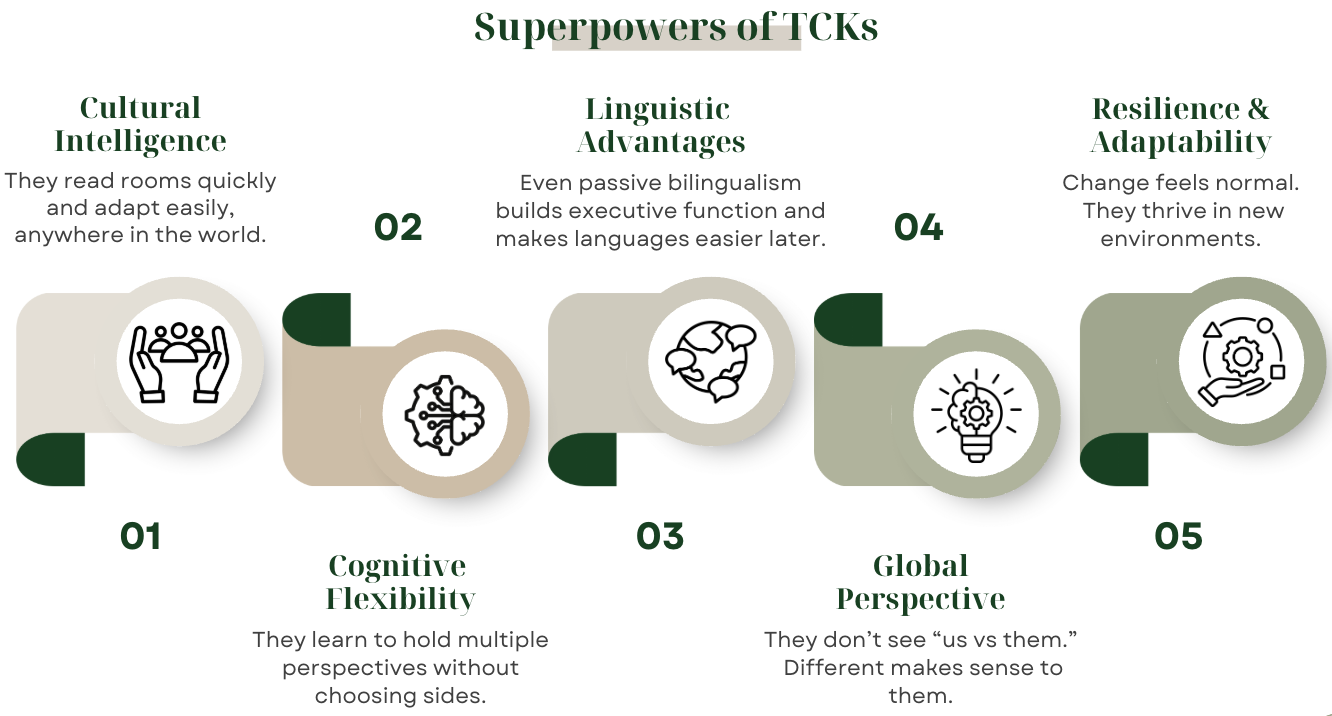
The problem was, I was so focused on what my kids were losing, I could not see what they were gaining.
Because when I would see other kids, Indian kids who spoke Hindi fluently, who were confident in their culture, who knew the prayers and the traditions, all I felt was guilt.
Other parents seemed to be doing it. Why couldn't I?
I would try to teach my kids one single prayer. Just one.
And they would roll their eyes. They would be embarrassed to say the words. The language felt awkward in their mouths.
They had no interest. None.
Because to them, it was not their culture. It was mine.
I had something beautiful to give them. Thousands of years of wisdom, tradition, and belonging.
And it was slipping through my fingers.
When Immersion Is Not Enough
Then we moved to Dubai.
And suddenly, we were surrounded by Indians again.
People speaking Hindi everywhere. Indian restaurants on every corner. Bollywood music blasting from car windows. The smell of chai and samosas at the mall.
My kids started learning Hindi as their mother tongue in school. They were in classes with other Indian kids. They were finally immersed in the culture.
I thought, This is it. This will fix everything.
Dubai will do what I could not. It will make them Indian.
And it helped. It did.
My kids were being immersed in Indian culture more than they ever were in London.
They started recognising Hindi words. They made Indian friends. They attended Diwali celebrations at friends’ houses.
But immersion was not the whole answer.
The real shift. The thing that actually changed everything.
That did not come from Dubai.
It came from a book club.
A few weeks ago, I joined this group of women. We meet once a week to study one of our sacred scriptures.
We sit on the floor, in a circle, cushions scattered around.
We start by chanting lines from the scriptures. Then we open the discussion.
That particular day, we were talking about the importance of reading this scripture. How it applies to modern life. How the teachings from thousands of years ago are still relevant today.
And I am sitting there, listening to these women talk about their kids. About how they use stories from the scriptures to teach their children about morals, about values, about how to navigate hard situations.
And I realised.
My kids do not know any of this.
They do not know the stories. They do not know the teachings. They do not have this foundation that I grew up with.
And it is not because I did not try. It is because I had drifted so far from it myself that I did not have anything to give them.
When it got to me, I just started crying.
I said, “This feels like a homecoming.”
Because that is what it was. After eleven years of drifting, of feeling disconnected, of letting go bit by bit, I was finally coming home. To my culture. To myself.
And this was the thing I had been missing the whole time.
I could not give what I did not have.
I could not pass on a culture I was not actively living myself.
My kids did not need me to perform culture. They did not need me to throw one big Diwali party a year and check the box.
They needed to see me living it. Daily. Authentically.
If it was not real for me, it would never be real for them.
So I made some changes.
I signed the kids up for cultural classes.
But more importantly, I started having conversations I had been avoiding.
Conversations about why it is so important for them to attend these classes. Not because I am forcing them to be Indian. But because this is part of who they are.
Conversations about our scriptures. About how the stories might seem old and irrelevant, chariots and kingdoms and ancient wars.
But they are not. They are about the same struggles we face today. Jealousy. Anger. Doubt. Fear. Just in a different context.
And I started bringing culture into our daily life.
We play chants in the morning. Calming verses from the scriptures to start our day.
We read a child's version of the scriptures together every night before bed. Just a few pages. A story here and there.
I go to the book club every week. I talk to them about what I learned.
And I am learning alongside them.
That is the key I had been missing.
You cannot outsource cultural transmission. You cannot schedule it once a year. You have to live it.
And honestly, I feel so much more grounded now. More calm.
I do not get swept up in things the way I used to. Or if I do, I come back to centre faster.
Because I have woven chanting, breathing, and reflection into my own day.
I go to the book club every week. I read up in advance. I am actually interested in learning about these teachings now.
That’s the big change.
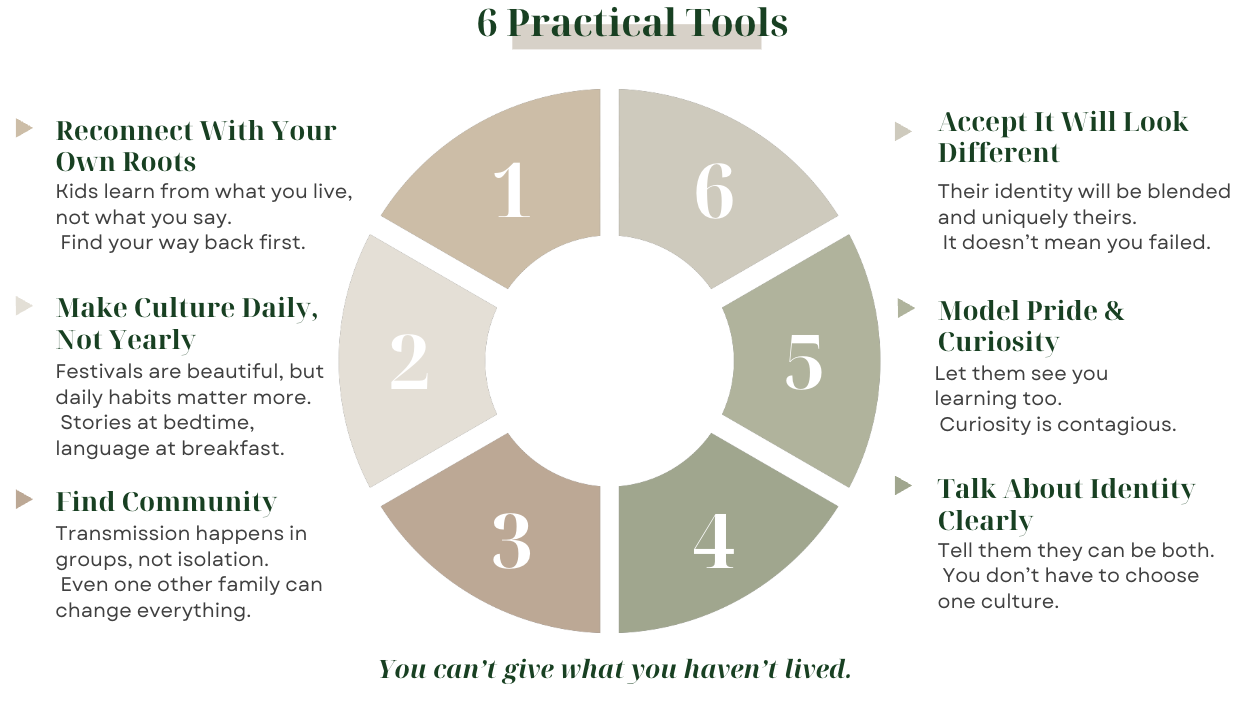
How to Help Your Third Culture Kid Feel Rooted
I wish someone had told me years ago that if you are raising Third Culture Kids, no matter what your heritage is, no matter where you are raising them, here are six things that actually work.
1. Reconnect With Your Own Culture First
You cannot teach what you have lost touch with.
So find your way back first.
Join a community. Take a class. Read your scriptures or your literature. Cook the food. Go to the temple or the church or the mosque. Listen to the music. Watch the films.
Whatever brings you back. Do that.
Because your kids are watching you, not listening to you.
2. Make Culture Daily, Not Just Festive
Annual celebrations are beautiful. They matter. But they are not enough.
Culture lives in the ordinary moments.
It is the language you speak at breakfast. The stories you tell at bedtime. The music you play in the car. The values you reference when you are disciplining them. The food you cook on a random Tuesday.
It is not about grand gestures. It is about small, consistent moments that add up over time.
3. Find Your Community
Cultural transmission happens in community, not isolation.
Seek out families from your heritage.
Join cultural classes.
Go to community events.
Find WhatsApp groups with other expat parents.
Connect with other Third Culture Kid families who understand what you are going through.
Because when your kids see other kids like them, kids who speak the language, who celebrate the festivals, who know the traditions, it normalizes it.
It stops being that weird thing my mum makes me do and starts being something other people my age also do.
You cannot do this alone. And you should not have to.
4. Talk About Identity Explicitly
Do not assume they will figure it out on their own. They will not.
Have the conversations.
This is where we come from. This is what matters to us. This is who you are.
And be prepared for them to push back. To say they are not Indian, or Chinese, or Nigerian. That they are British or American or Emirati.
Do not dismiss it. Do not correct them.
Just say, You can be both. You do not have to choose.
In a world where they are constantly asked Where are you from, and it is always a complicated answer, they need to know that complexity is okay.
Let them know they can be all of it. Fully Indian and fully British. Or Indian and British and Singaporean. However many cultures are woven into who they are, they get to claim all of them.
5. Model Pride and Curiosity
Let your kids see you curious. Asking questions. Learning. Exploring your heritage even as an adult.
And let them see you proud. Genuinely proud of where you come from.
Because kids can smell inauthenticity a mile away.
If you are embarrassed about your culture, they will be too.
But if you are genuinely interested, genuinely proud, they will be curious too.
6. Accept It Will Look Different
And finally, let it be messy.
Your kids will not have your childhood. And that is okay.
Their identity will be blended. Complex. Uniquely theirs.
They might not speak your language fluently. They might prefer pasta to biryani. They might celebrate Christmas with the same enthusiasm as Diwali or Eid or Lunar New Year.
And that does not mean you failed.
It just means they are Third Culture Kids.
And that is its own beautiful thing.
I grew up in Singapore with deep Indian roots. Grandparents around the corner. Community everywhere. Culture woven into every day.
My kids are growing up across borders. Singapore. London. Dubai.
I cannot give them my childhood.
But I can help them feel rooted in who they are, wherever we are.
I can show them that home is not a place. It is a set of values. A way of being. A connection to something bigger than themselves.
And it starts with me reconnecting first.
It is not too late. Not for me. Not for you.
Whether your kids are five or fifteen, whether you have been abroad for two years or twenty, whether you have already failed at passing on your culture or you are just starting out,
it is not too late.
It just starts with you.
Are you raising Third Culture Kids?
What culture are you trying to pass on, and what has been the hardest part?
Drop it in the comments. I would love to hear your story… because I guarantee you, someone else in this community is going through the exact same thing.
And speaking of cultural transmission and education, I recently had to make a choice about whether to enroll my kids in Kumon, even though I am a Montessori guide. That blog post is linked here if you want to see how that went.
See you there.