The Truth Behind Parenting Styles (And Why Montessori Isn’t One)
"Montessori gives kids too much freedom."
"It's too strict, it has too many rules."
Wait… those are opposites. Here's why everyone is confused: Montessori isn't a parenting style.
So what is it? I spent two years calling myself a "Montessori parent" and I had no idea. I had the wooden toys. I had the perfect shelf rotation. I had the Instagram aesthetic. But I didn't actually understand what I was doing or why.
And if you're here right now thinking,
"Wait, am I doing Montessori wrong? Am I authoritarian? Am I too gentle? Where do I even fit?"
I get it. Because that was me.
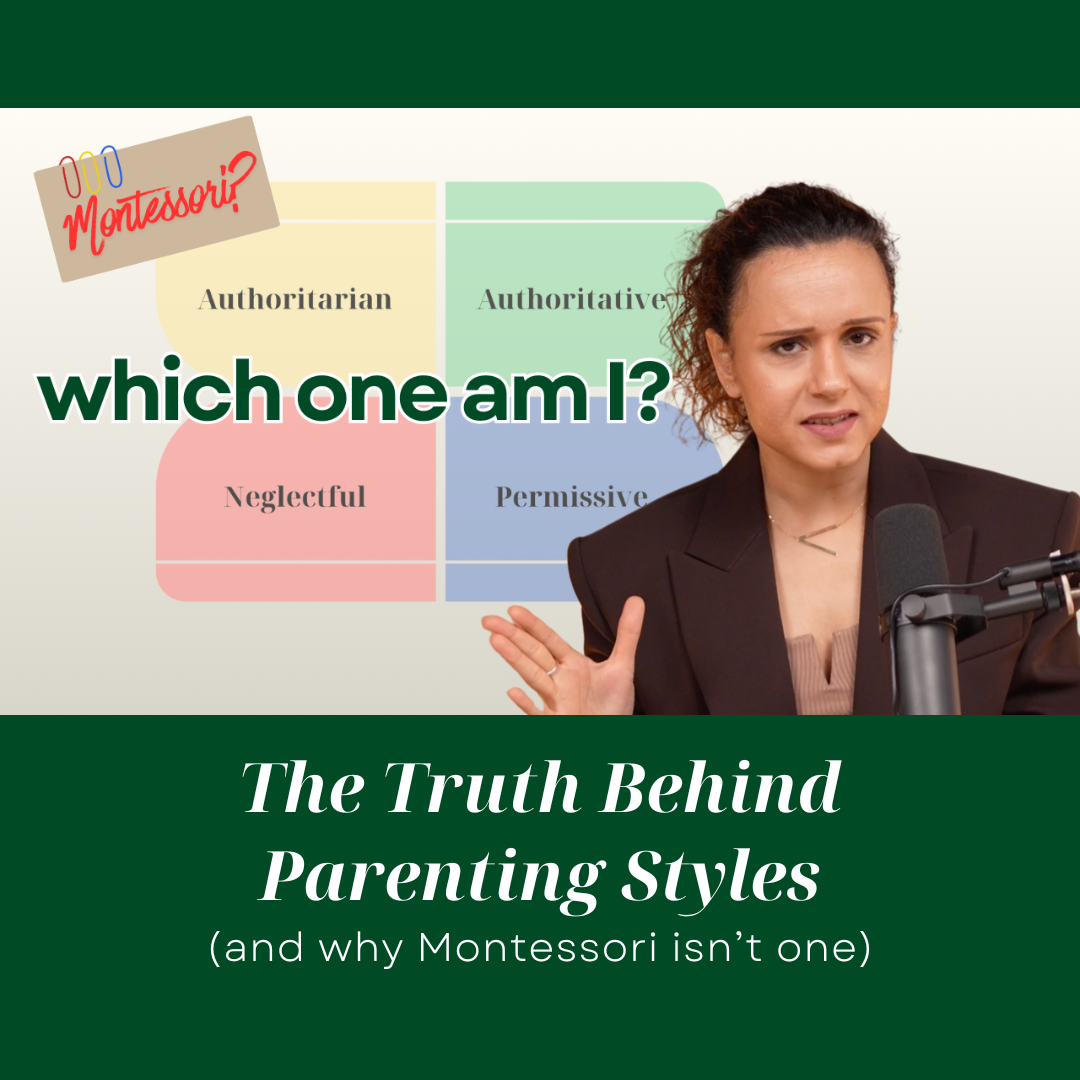
Here's what nobody tells you: Montessori is an educational philosophy. It aligns perfectly with one research-based parenting style, and once you know which one, all the confusion disappears.
So in this post, I'm going to show you the four parenting styles, not with boring definitions, but with real scenarios so you can actually see the difference. Then I'll break down what Montessori actually is. The real version, not the Instagram version. And finally, I'll tell you which parenting style Montessori aligns with.
Because once you understand this, you can stop trying to be perfect and start making choices that actually work for your family.
And there is one parenting style that is basically Montessori's twin. Stick with me, I will tell you which one in a few minutes.
The Moment I Realised I Didn’t Understand Montessori At All
My son is six months old. I'm sitting on the living room floor rearranging his toy shelf for the third time this week. Rainbow stacker on the left. Teething rings in the middle. Contrast cards on the right. I step back, take a photo, post it to Instagram.
And I genuinely think this is Montessori. If I just get the shelf right, my son will be more independent. He will develop faster. He will love learning.
But here is what I'm not doing: watching my child. He's on his mat trying to roll over. His arm keeps getting stuck. And instead of letting him work through it, I keep interrupting him to show him a new toy I just bought.
I thought I was being a good Montessori mom. But I was just performing for Instagram.
So then I start reading everything. The Conscious Parent. Gentle parenting books. Attachment parenting. I'm stacking them on my nightstand, lying in bed at night thinking, am I a gentle parent? A conscious parent? Where does Montessori even fit?
I need to know which box I fit into. Because if I can just figure out the label, I can do it right. But the more I read, the more confused I get.
When I was pregnant, I asked everyone: What is Montessori?
One mom said, "It gives kids way too much freedom. They just do whatever they want." Another mom said, "It's so rigid. There are so many rules."
And I'm standing in that toy store, eight months pregnant, holding that wooden rainbow stacker, thinking, wait, those are opposites. How can both be true?
It took me years and a Montessori diploma to figure out why everyone was so confused. And it all comes down to one thing nobody talks about...
The Four Parenting Styles
(Explained With Real Examples)
So I'm at this parenting talk.
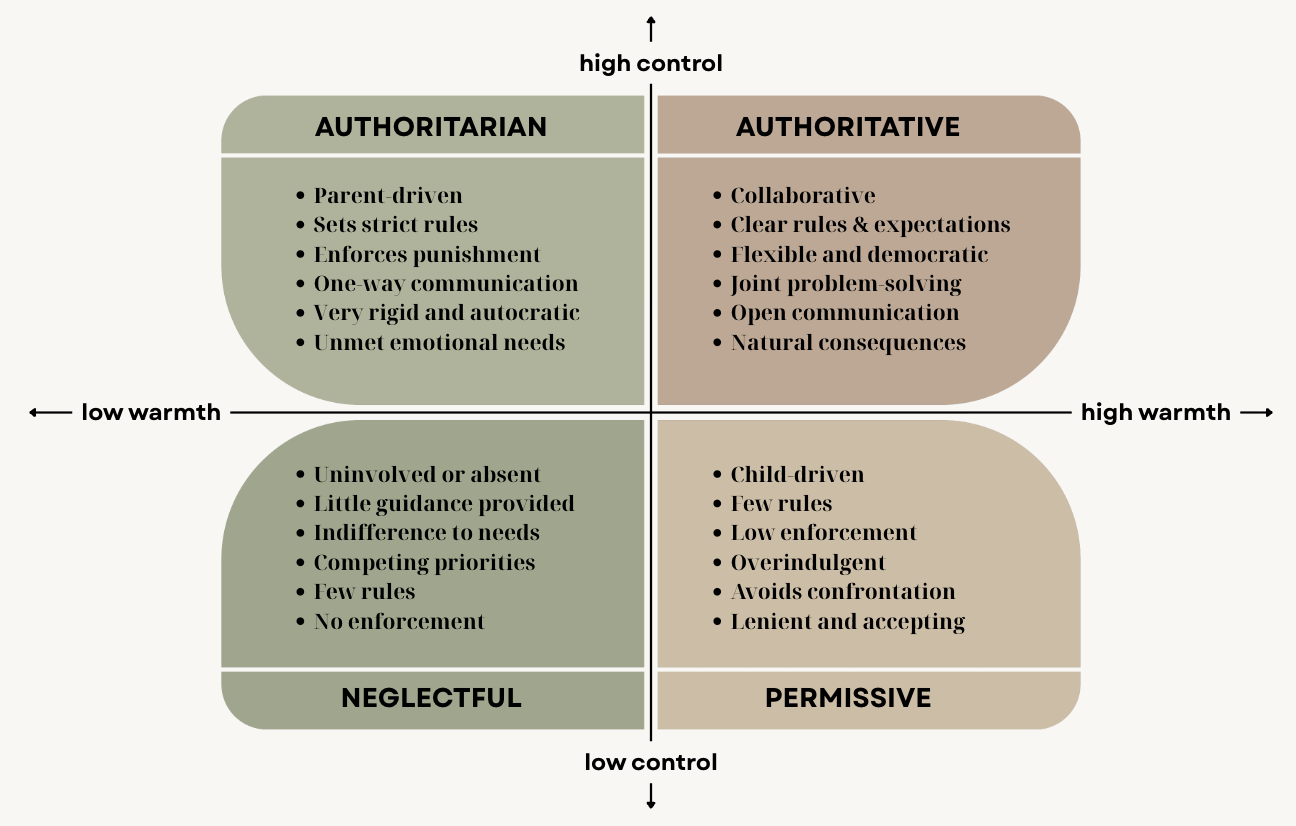
The speaker puts up a slide with four quadrants. Warmth on one axis, control on the other.
And she says:
"Parenting styles aren't about what you do with your kids, the activities, the toys, the methods. They are about how you relate to your child. Two things: how much warmth you show, and how much control you exert."
And it hits me. I have been confusing parenting styles with parenting methods. Montessori, gentle parenting, attachment parenting… these are methods. They are about what you do.
But parenting styles are about the relationship itself. The dynamic between you and your child. So let me break down the four research-based parenting styles, and I'm not going to give you boring definitions. I'm going to show you what each one actually looks like in real life.
Authoritarian Parenting (High Control, Low Warmth)
Picture this: It's 6:30 on a Wednesday. Seven-year-old Emma is at the kitchen table with her math homework. She's been stuck on the same problem for ten minutes.
Her dad walks in. Glances at the paper. Sees she got it wrong. He doesn't ask what she's struggling with. He doesn't sit down. He just says, "That's wrong. Do it again."
Emma's eyes fill with tears. She erases it. Tries again. Gets it wrong again. "I don't understand," she says quietly.
"You need to focus harder," her dad says. "No TV until you get it right." He walks out.
Emma is alone at the table. She is not crying anymore; she is just staring at the paper, frozen. She doesn't know how to get it right, and she knows if she asks for help again, she will just get in trouble.
In that moment, Emma learns something: Her feelings don't matter. Obedience does. And over time, that becomes her inner voice. Don't ask questions. Don't mess up. Just do what you're told.
This is authoritarian parenting. High control, low warmth. These kids often follow rules well. But research shows they struggle with anxiety, low self-esteem, and making decisions on their own. Because they were never taught how to think, only what to think.
Permissive Parenting (Low Control, High Warmth)
It's Saturday morning at the grocery store. Four-year-old Liam is pushing the cart, or trying to. He's ramming it into displays, knocking over cereal boxes. His mom is trailing behind, saying, "Liam, sweetie, be careful," but she's not actually stopping him.
They get to check out. Liam sees the candy, grabs three chocolate bars, and tosses them in the cart.
"Liam, honey, we're not buying candy today," his mom says.
Liam looks at her. Then he starts screaming. Full meltdown. On the floor, kicking, crying.
His mom looks around. Everyone is staring. She crouches down and says, "Okay, okay, you can have one. Just one."
Liam stops crying immediately. Picks the biggest chocolate bar. They go home.
And Liam learns something: If I scream loud enough, I get what I want.
By the time Liam is ten, he is the kid who argues about everything. Bedtime is a negotiation. Homework is optional.
And his mom is exhausted. She loves him so much, but she has no idea how to set a boundary without feeling like the bad guy.
This is permissive parenting. Low control, high warmth. Kids raised this way feel loved, but without boundaries, they struggle with impulse control, entitlement, and handling disappointment.
Neglectful Parenting (Low Control, Low Warmth)
This next one is harder to tell. But it is important.
It is Tuesday afternoon. Twelve-year-old Maya is sitting on her bed staring at her phone. She got a 98 percent on her science test today, the highest grade in the class. She has been waiting all afternoon to tell someone.
Her mom gets home from work at 6:30. Maya hears the door open. She walks downstairs.
"Mom, guess what? I got a 98 on my…"
Her mom barely looks up. She is scrolling through her phone, kicking off her shoes.
"That's great, honey. Did you eat?"
Maya nods. She waits. Hoping her mom will ask to see the test. Hoping she will say something more.
But her mom walks to the couch, sits down, and turns on the TV.
Maya walks back upstairs, test still in her backpack, and she thinks, it doesn't matter what I do. No one cares anyway.
Over time, Maya stops trying. She stops bringing home good grades. She stops talking about her day.
This is neglectful parenting. Low control, low warmth. Kids raised this way often struggle with attachment issues, low self-esteem, and difficulty trusting others.
Authoritative Parenting (High Control, High Warmth)
Now, authoritative parenting. Here is the difference.
It is Thursday evening. Six-year-old Noah is sitting at the kitchen table with his dad. They are working on a puzzle together. Noah picks up a piece, tries to fit it in the wrong spot. It doesn't work.
He gets frustrated. "This is stupid!" He shoves the piece away.
His dad doesn't react immediately. He sits there for a second. Then he says, "I can see you're frustrated. Puzzles are hard sometimes."
Noah looks at him. His dad picks up the piece and holds it gently.
"What if we try looking at the colours first? See how this piece has blue on the edge? Where else do we see blue?"
Noah takes the piece. He looks at the puzzle. He finds the blue section. When the piece clicks into place, his face lights up.
"I did it!" he says.
His dad smiles. "You figured that out. You did not give up, even when it was hard."
And Noah learns something: I can do hard things. When I struggle, someone is here to guide me, not do it for me, but help me figure it out.
This is authoritative parenting. High control, high warmth. These parents set clear boundaries, but they also explain them. They listen to their child's perspective. They encourage independence within limits.
What Montessori Actually Is
So if Montessori isn't a parenting style, what is it?
Montessori is an educational philosophy. It is not a parenting style. It is not a set of toys you buy. It was developed by Dr. Maria Montessori, the first female Italian doctor, in the early 1900s.
Picture this: It is 1907 in Rome. Maria Montessori has just opened the first Casa dei Bambini, the Children's House, in a poor neighbourhood. She is working with 60 children, ages three to six, from incredibly difficult backgrounds.
Instead of teaching them the traditional way, she observes them. She watches what they gravitate toward, what interests them, how they move. Then she designs an entire method of education around what she sees.
And what she discovers is revolutionary:
Children do not need to be forced to learn. They are born wanting to learn.
From that one insight, she built her entire method around a few key principles.
The Five Core Principles of Montessori
Observation
This means watching your child before you intervene. So if your baby is on the floor working on rolling over, you don't interrupt to show them a toy. You just watch. Because when you observe first, your child shows you exactly what they need.
Observation isn't passive… it's the most active thing you can do as a parent.
Freedom Within Limits
This is the one that confuses everyone. Here's what it means: Your child can choose any activity on the shelf… but they need to be shown it first. They can work for as long as they want… but they put it back when they're done.
It's not "do whatever you want." And it's not "follow these rules without question." It's structure that supports autonomy.
Respect for the Child
Even the youngest child deserves the same respect you'd give an adult. So instead of scooping up your toddler mid-play to change their diaper, you wait till they look at you and say, "When you're finished with that tower, we need to change your diaper."
You're not asking permission… you're acknowledging their work has value.
The Prepared Environment
This isn't about the perfect Instagram shelf. It's about setting up your home so your child can be independent. Low coat hooks so they can hang their own coat. Small glass cups so they learn to handle fragile things carefully. A step stool by the sink.
Everything at their level, so they can do things themselves.
Hands-On, Sensorial Learning
Montessori materials make abstract concepts concrete.
A five-year-old doesn't learn subtraction on a worksheet… she uses golden beads. She holds ten beads in her hand, then physically removes three. She doesn't just memorize "10 minus 3 equals 7." She experiences it.
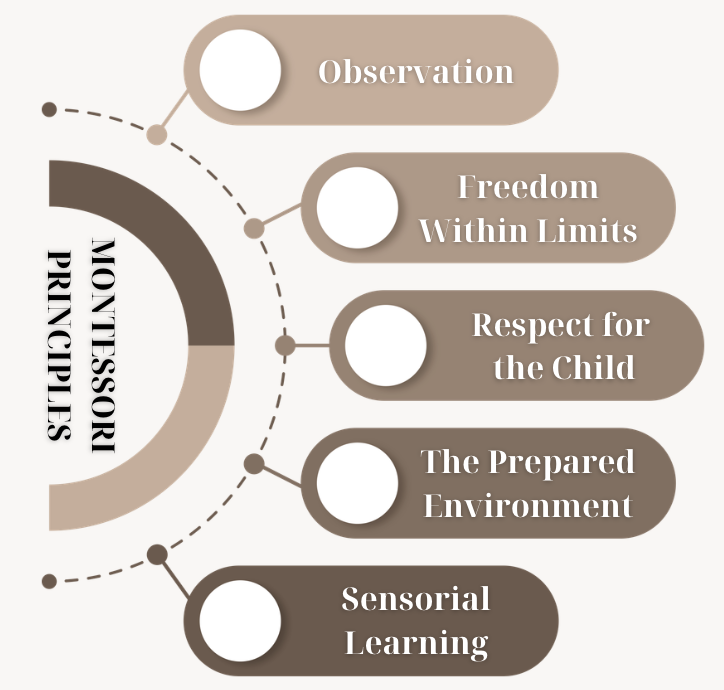
Montessori says children are naturally eager to learn. If you observe them, respect them, give them freedom within limits, prepare an environment that supports independence, and let them learn through their hands, they will flourish.
But it was designed for schools. Your home is still a home, and it does not need to look like a classroom.
Your toddler will watch TV sometimes. You will use a sticker chart if it helps. There will be days where the toys are everywhere. That is okay.
Montessori at home is not about perfection. It is about respect, observation, and independence.
Parenting Styles vs Montessori
Parenting styles are about your relationship with your child. How much warmth you show. How much control you exert.
Educational philosophies are about how children learn best.
They do not automatically go together.
You can be authoritative and send your child to a traditional school. You can be permissive and have Montessori materials at home. You can be authoritarian and follow Waldorf.
Buying wooden toys does not make you authoritative. Setting boundaries does not make you Montessori.
But Montessori naturally aligns with one parenting style.
The Parenting Style That Aligns With Montessori
So which parenting style does Montessori align with?
Authoritative parenting.
Think about it:
Authoritative parents set clear boundaries and explain them, encourage independence within limits, listen to their child's perspective, and are firm but loving.
Montessori offers freedom within limits, respect for the child, observation and following the child, and a prepared environment that encourages independence.
Both approaches say the same thing: guide, do not control. Boundaries with respect. Warmth with structure.
When people say Montessori gives kids too much freedom, they are thinking of permissive parenting.
When people say Montessori is too strict, they are thinking of authoritarian parenting.
Montessori is neither. It sits in the middle: freedom within limits, boundaries with respect.
It aligns with authoritative parenting.
You do not have to fit perfectly into one box.
I'm not a perfect Montessori parent. I have yelled when I should have paused. I have interrupted their concentration. I have bought toys instead of observing. But my kids do not need me to be perfect. They need me to see them, respect them, and trust that they are capable.
You can mix Montessori with gentle parenting. You can use traditional methods if they work for your family.
Montessori is not about the toys. It is about seeing your child as capable.
Parenting styles are about your relationship with your child.
Montessori is an educational philosophy.
The two are separate categories, but they align beautifully when paired intentionally.
Authoritative parenting and Montessori share the same core values: firm but loving, freedom within limits, and boundaries with respect.
Once you understand that, everything becomes clearer. You stop second-guessing. You start trusting your child, and yourself.